

Experimental: ARC II — Chronomara
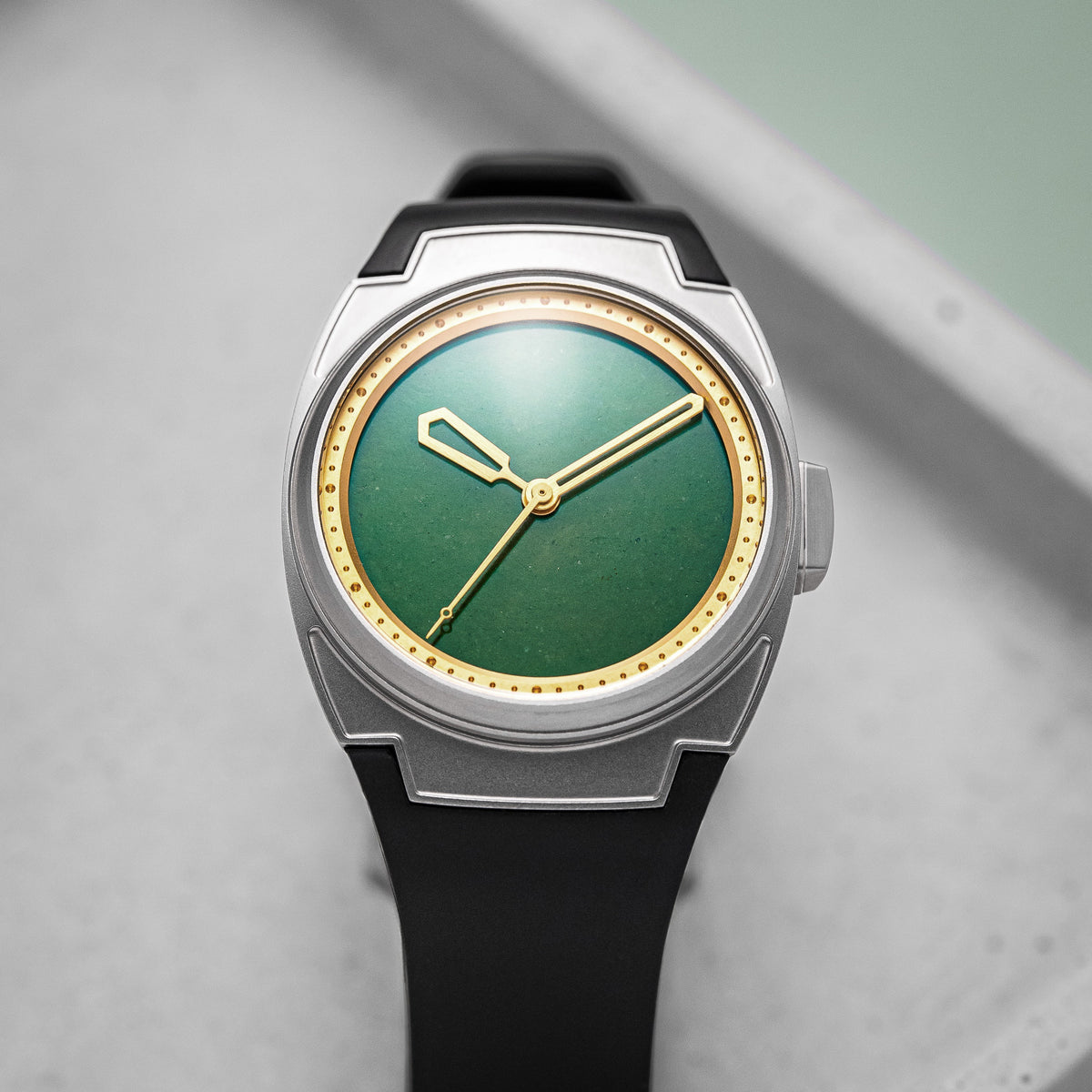
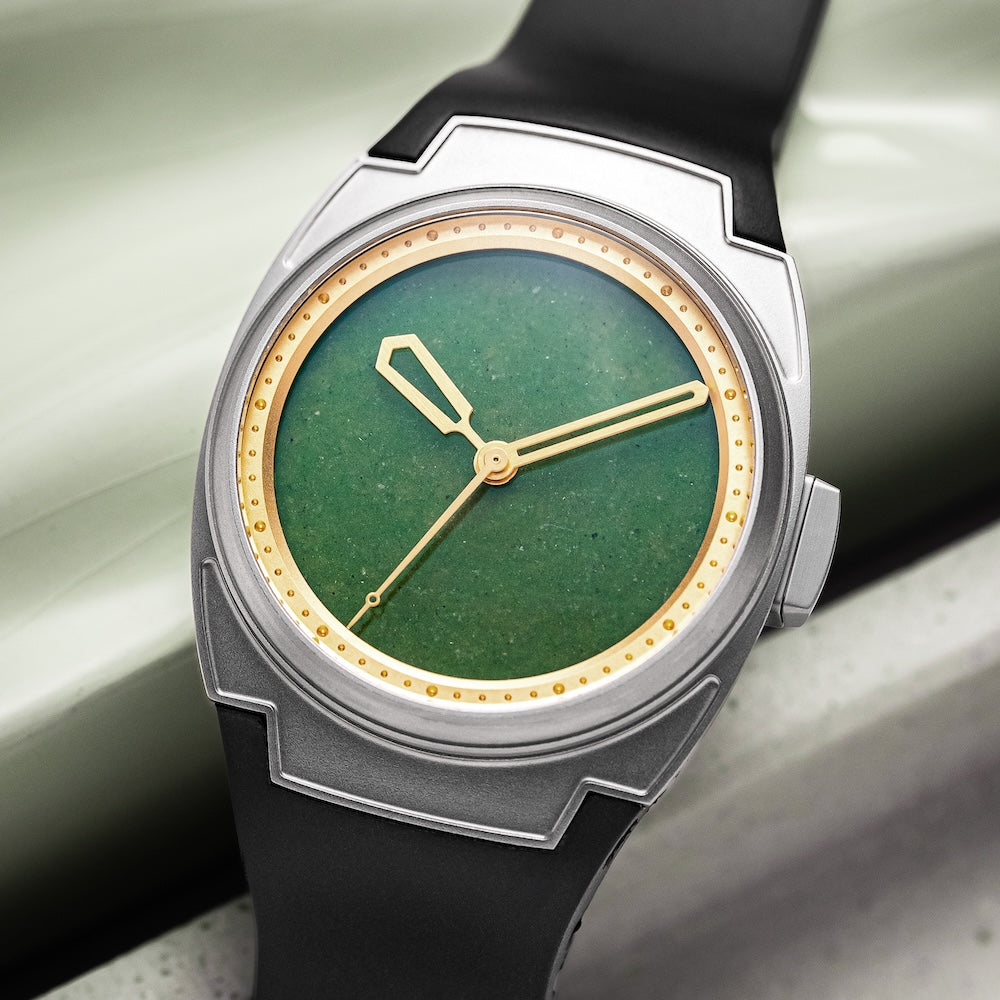
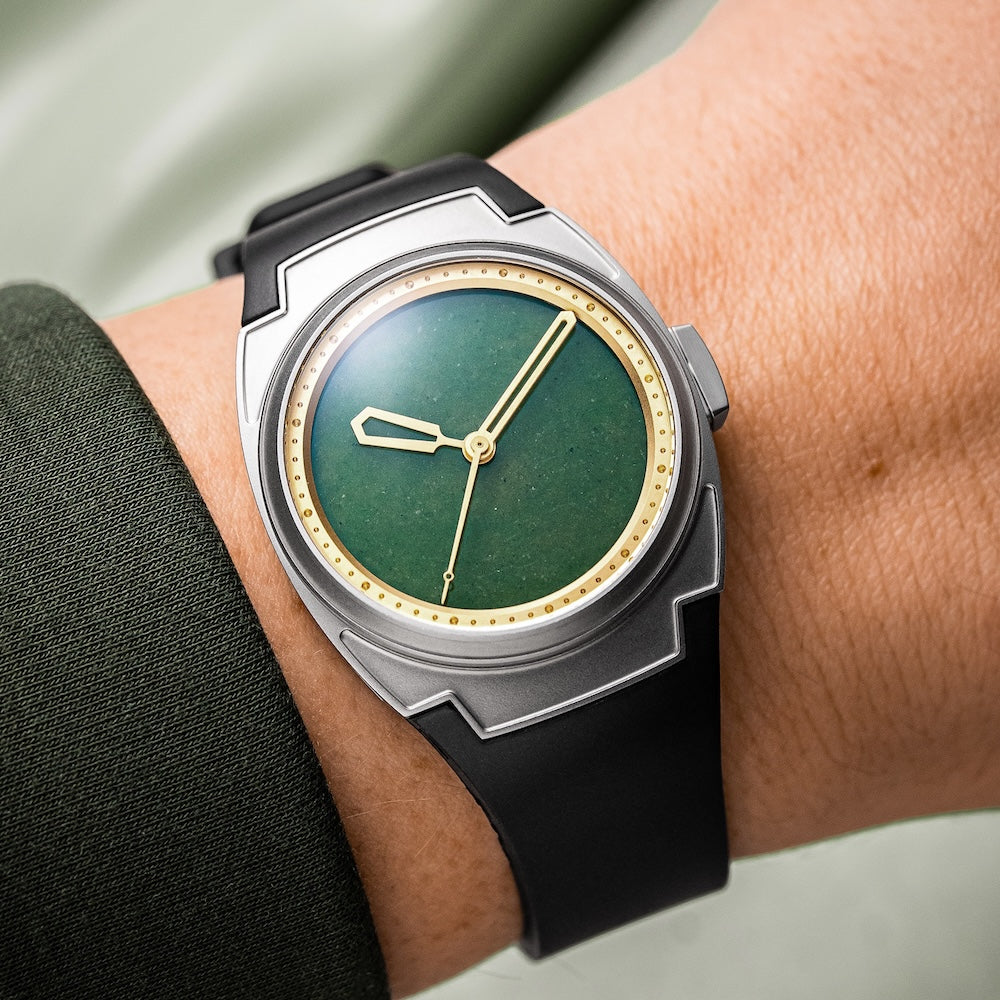
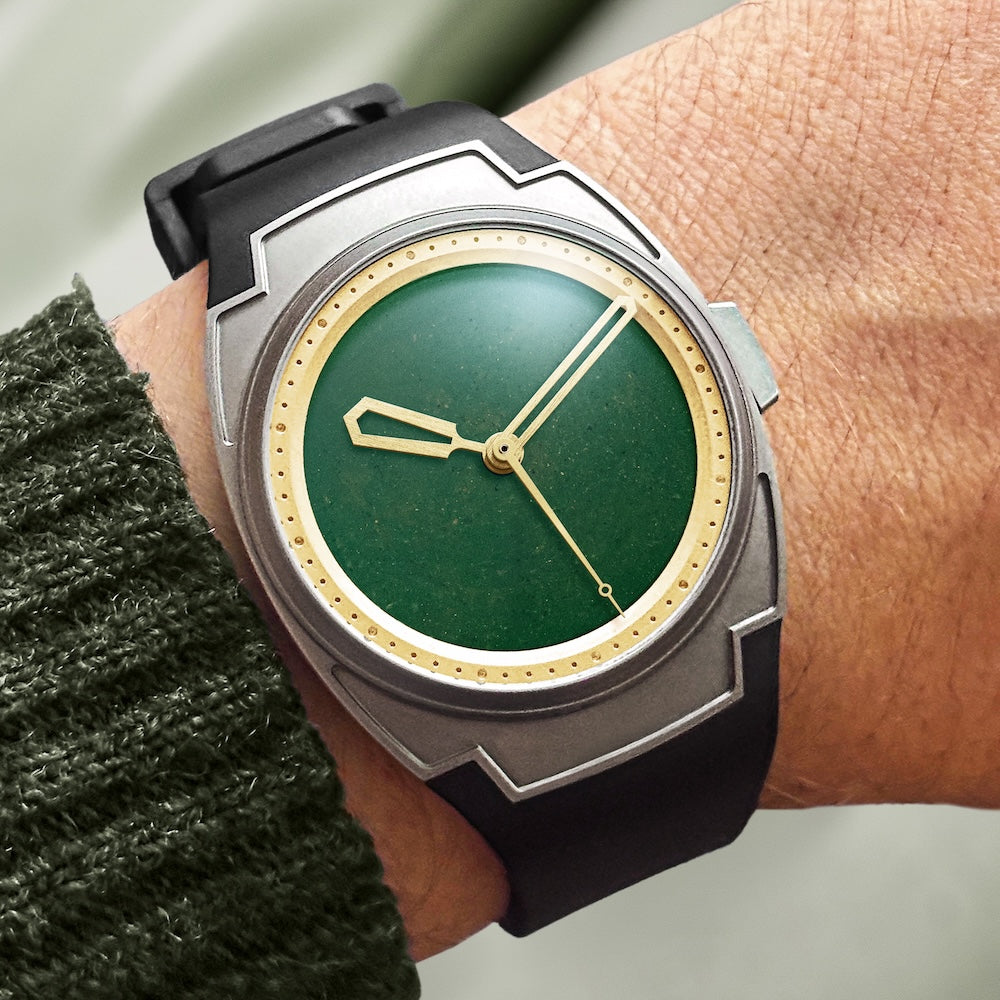
The Arc II — Chronomara brings Irish Connemara marble to life with a luminous composite dial, handcrafted in Copenhagen. Created in honour of independent watchmaking champion Johnny McElherron, it combines Irish heritage with Scandinavian experimentation.
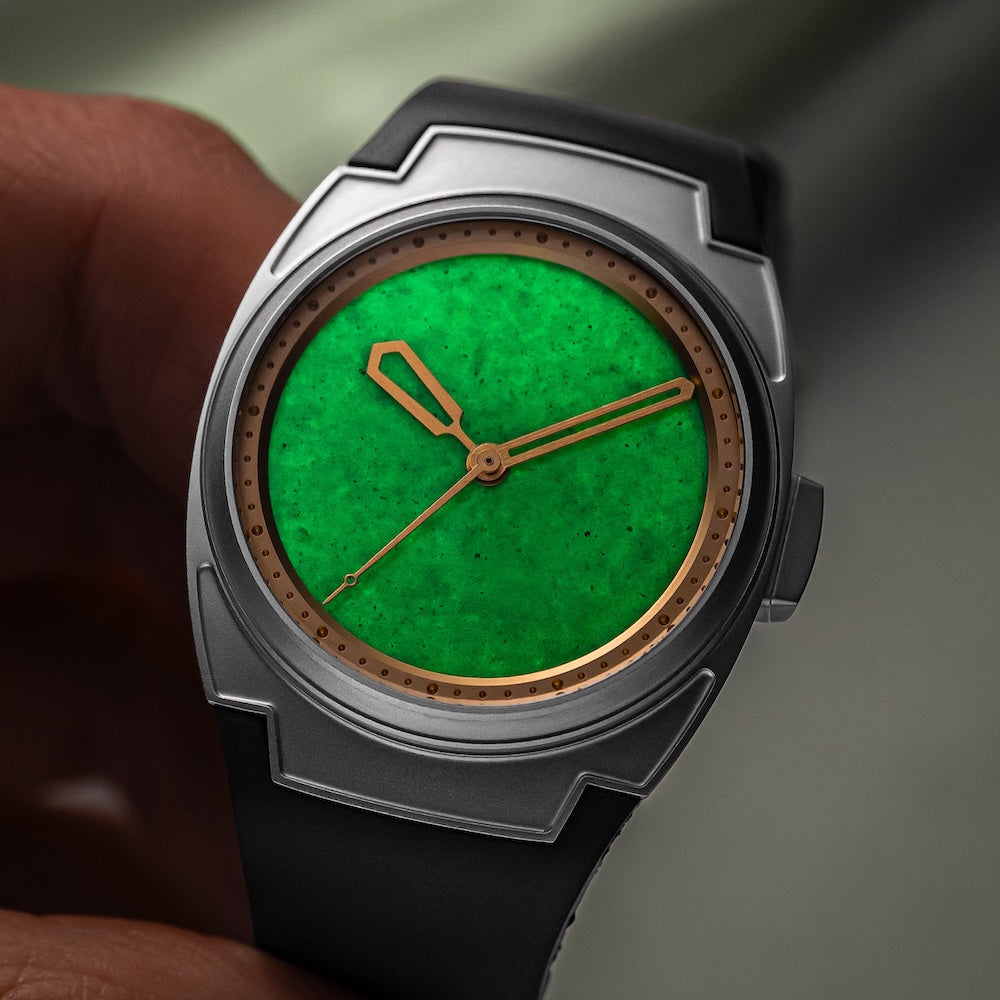
We crush the marble and transform it into a semi-translucent hand polished composite, preserving its rich green character. Layered above solid Lumicast and beneath a sapphire disc, the dial reveals depth by day and an intense characterful glow after dark. It marks the debut of our new four-layer dial construction, opening new possibilities for combining natural materials and light. Limited to 66 individually numbered pieces across 37 mm and 40.5 mm sizes.
Only 15 pieces assembled in 2026
ABOUT ARCANAUT
Arcanaut is an independent Danish watchmaking studio redefining contemporary horology through material experimentation.
We explore unconventional materials, methods, and designs, developing new dial-making techniques, crafting each dial by hand in small batches.
Every watch is assembled in our Copenhagen workshop, with a significant share of components produced locally across Denmark and Sweden.
Our watches are defined by bold, expressive dials, distinctive Nordic case design, and playful casebacks that add narrative and character.
ABOUT THE RELEASE
What is it?
The Arc II – Chronomara was originally created for our good friend, supporter, and Irish retailer Johnny McElherron, who runs the Watch Press, hosts the In The Metal podcast, organises The Festival of Time event, and connects clients to respected independent watchmakers via his retail business, Chronolux Fine Watches.
We wanted to create something that celebrated the culture and heritage of one of Arcanaut’s most beloved international partners, and so, just as we did with Chronoshop in Czechia with the Garnet Goblin, we spent a couple of years developing and refining a material we felt did just that.
The Connemara marble used in the creation process is deconstructed and then reconstituted using Arcanaut’s proprietary composite creation process before becoming the most characterful ingredient of our unique four-layer dial sandwich (five, if you count the chapter ring).
Why is it important
Most brands work with the same stones over and over again. We love Onyx, Malachite, or Tiger’s Eye, but whenever we approach something that’s been done a lot, we at least want to put an Arcanauty twist on it and do it differently. Connemara itself is quite an unusual stone to begin with (in the context of watchmaking), but even so, rather than slicing it thinly and presenting a standard, hard stone dial, we decided to try something a little more ambitious, and integrate it with the high-performance lume for which we, and especially our co-owner James “Black Badger” Thompson is known.
Who is it for?
It is for the person who values rarity, design, and the story behind an object. For the collector who already knows the classics, and is more interested in seeing them pushed somewhere new. And for the person who wants a watch that does more than simply look good — one that sparks curiosity, invites questions, and rewards a closer look. In that sense, Chronomara is not just made to be worn. It is made to be discovered.
Delivery timeline
Every Arcanaut ARC II — Chronomara is built to order, by our small team of watchmakers in Copenhagen, Denmark.
We expect to dispatch the first 15 Chronomara watches in 2026 and remaining pieces throughout 2027.
Shipping, duties, and tariffs
Before dispatch, an Arcanaut representative will contact you to confirm delivery details, including shipping timing and final destination.
All prices include international shipping and insurance. However, for orders shipped outside the European Union or the United States, any applicable taxes, duties, tariffs, or customs charges are not included. Within the European Union and The United States the prices you see will include local VAT and/or all duties.
All shipments outside the European Union or the United States are sent DAP (Delivered at Place), meaning that any import-related charges remain the responsibility of the recipient.
Please note that Arcanaut reserves the right to decline refunds for watches that are returned, refused, or destroyed due to unpaid taxes, duties, tariffs, or other customs-related charges.
Payment
We take all international cards through Stripe and PayPal, but you are also welcome to pay via wire transfer (and if you do, you’ll receive an additional strap of your choice for free).
For some international transactions, your bank or card issuer may require additional authorization before approving the payment. If your payment is declined, we recommend contacting your bank or using an alternative payment method.
Options are available at checkout.
Should you have any issues completing your order, please contact us directly at info@arcanaut.dk or +45 61264316.
Size
The Arc II — Chronomara is available in two diameter sizes (excluding the crown). You can choose between 40.5 mm and 37 mm.
Please reference our visual size guide for diagrams of the different case sizes on different sized wrists, and scroll further down this page to play around with out slider tool, that shows both case sizes on real life wrists.
Dimensions:
40.5 mm/49 mm lug-to-lug/14 mm thick (including crystal).
37 mm diameter/45 mm lug-to-lug/13.3 mm thick (including crystal).
Please be aware that our cases do not have lugs in the traditional sense. Instead, they have a single “central” lug.
Therefore, the lug-to-lug measurement provided represents the maximum length of the watch case along its central axis.
If you're unsure about the size we recommend ordering a 3D-print.
Technical information
Name: Arcanaut Arc II — Chronomara
Assembly: Regulated and assembled in Copenhagen Denmark
Dimensions: 40.5 mm diameter/49 mm lug-to-lug/14 mm thick (including crystal). OR:
37 mm diameter/45 mm lug-to-lug/13.3 mm thick (including crystal)
Case: Micro-blasted stainless steel case with “skeleton framing”
Water resistance: 100 m
Dial: Luminous Connemara marble composite
Hands: gold plated hours, minutes, and seconds
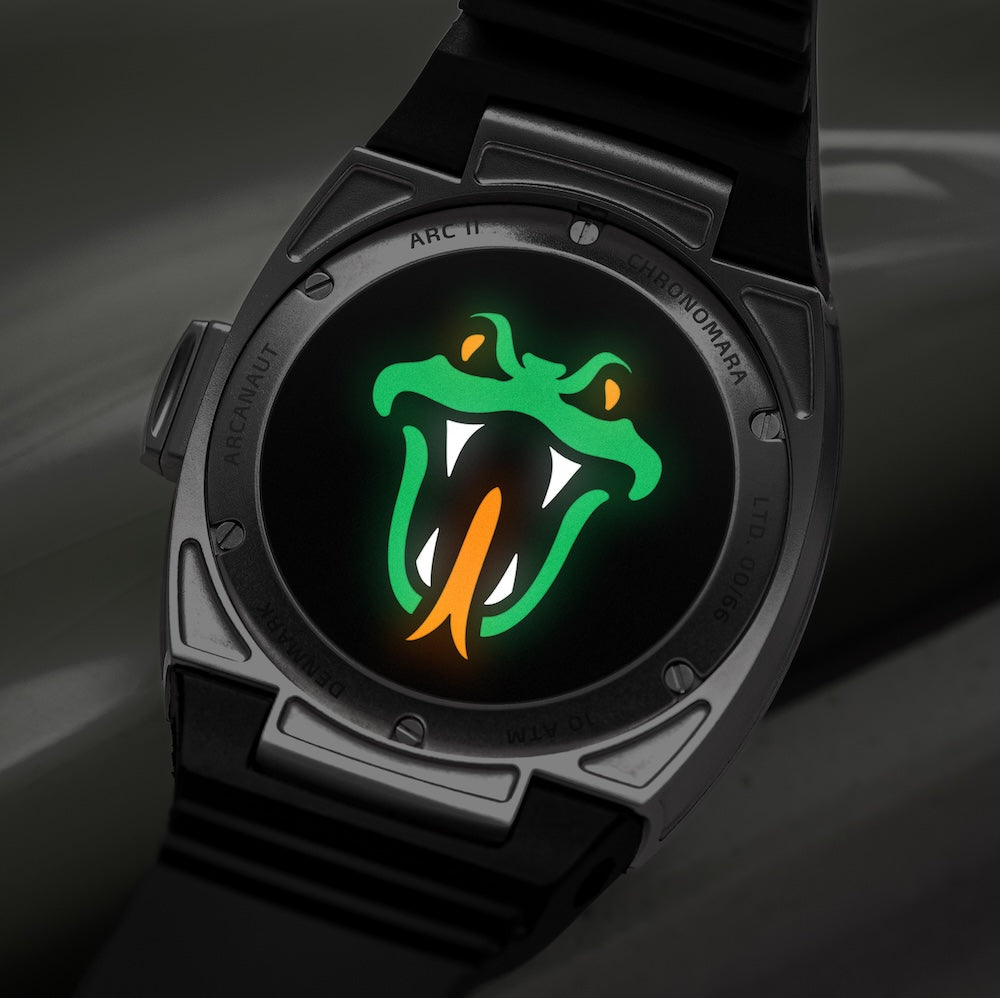
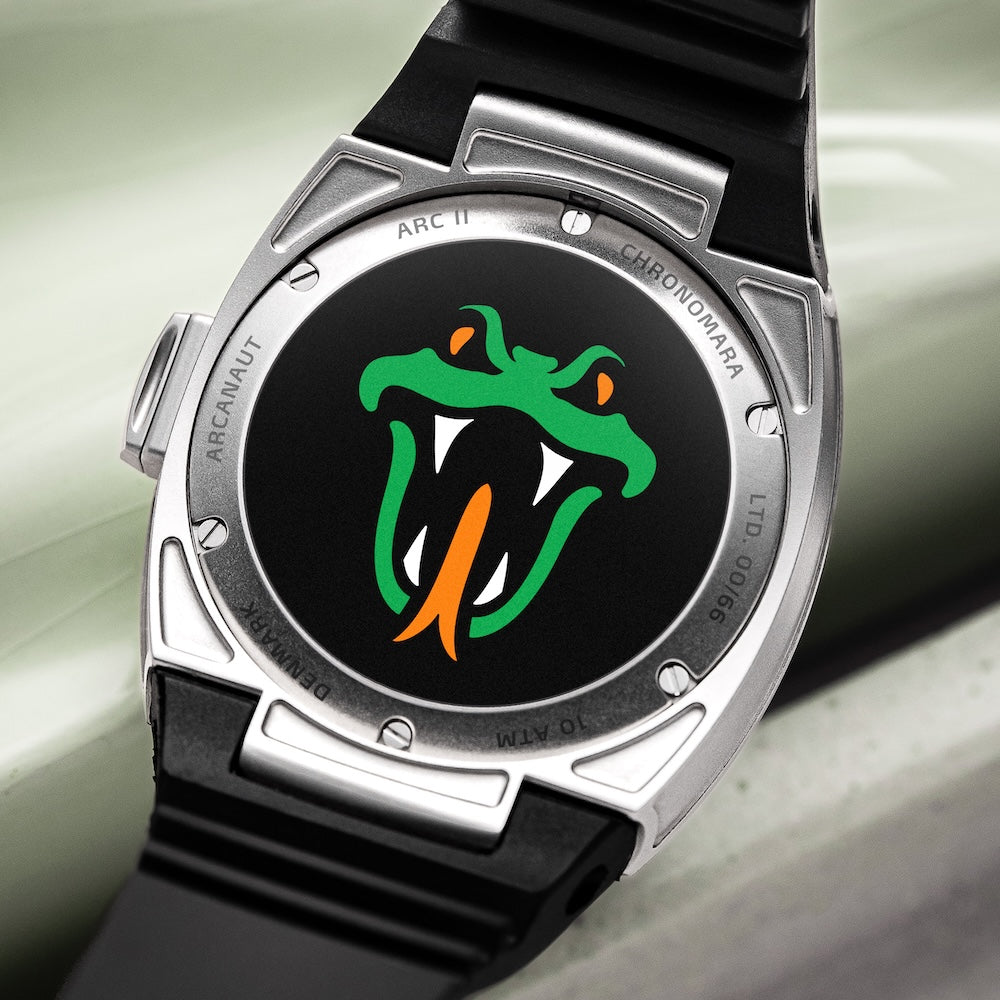
Movement: La-Joux Perret G101, Swiss Automatic (closed 4G GlowPatch caseback with snake motif)
Functions: Time only
Power reserve: 68 hours
Limitation: 66 pieces in total across both sizes
FAQ
Do you ship worldwide?
Yes, we do. For customers outside the EU the retail price excludes import duties, tariffs and VAT, but includes free international shipping and insurance from Denmark.
Will the series be individually numbered?
All Chronomara pieces will be individually numbered.
Serial numbers will be assigned according to the order in which orders are placed — meaning the first order will receive No. 1, the second order No. 2, and so on.
If you have a special serial number request, please get in touch, once your order is confirmed by email, and if that number is available, we will assign it to you.
When can I expect the watch to ship?
We expect to dispatch all orders within eight weeks of order confirmation.
How will my watch be delivered?
Your watch will ship in a Arcanaut-branded leather watch roll, protected by a Danish hand-made riveted box. A screwdriver for changing straps is included. If you order additional straps, these will be shipped within the box.
What is the total price of the watch delivered?
Additional charges vary by country, so we recommend contacting your local customs or tax office to get a full landed cost estimate before purchasing. That way, you’ll know exactly what to expect — no surprises.

Time To Layer Up
The Arc II — Chronomara is our first commercially-available model to feature an entirely new dial system that we have been developing at Arcanaut for years, bringing together our experience in composite creation, lume performance, and structural refinement.
It combines two of our core strengths — lume and composites — in a four-layer sandwich dial architecture (five, if you count the 9-karat gold-plated stainless steel chapter ring "cup", which holds everything together) designed to enhanced the feeling of depth, arresting light play on the dial, and legibility in all conditions.
The top layer is a sapphire crystal disc, treated with a green anti-reflective coating. Beneath it sits a slightly opaque composite made from deconstructed (read: crushed) Chronomara, followed by a solid Super-LumiNova disc in a custom Kelly green developed exclusively for this project.
These three layers, each with its own texture and properties, sit atop a nickel-plated baseplate, chosen for its white tone and reflective surface, which helps charge the lume and keep it charged.
Connie, who?
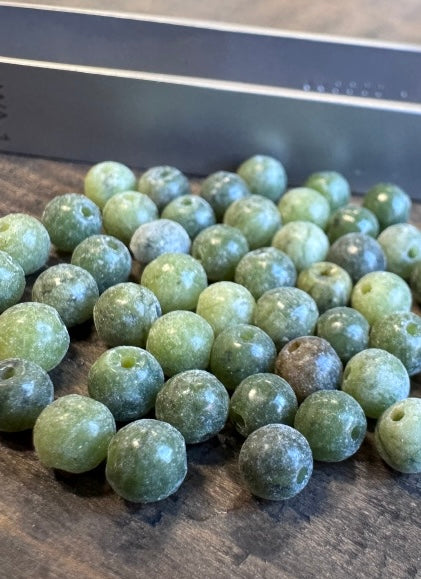
Connemara marble isn't exactly the most commonly talked-about stone.
It doesn't get anywhere the pop of something like an onyx, a malachite, or, say, a Tiger's Eye.
Watchmaking has its favourites, and for good reason. The stone dials you see most brands deploying these days are ubiquitous, cheap to source, slice, and finish.
The popularity of hard stone dials has led to an increase in suppliers and the volume supplied. This, in turn, stimulates a fine-tuning of the manufacturing processes, slashing prices. The specialised processes for doing exactly this to stone dials becomes perfected. For us, that was too easy...
We wanted to take a material that has never been used in a watch at this level, and certainly not in this way. Bigger brands that demand massive volumes would hate to work with such a variable, unpredictable stone. Slicing it is possible, but finding enough pleasing slices to make a mass volume series of legible dials? Good luck.
We fell in love with Connemara marble. Whether we wanted to work with was not the question. Exactly how we did that was...
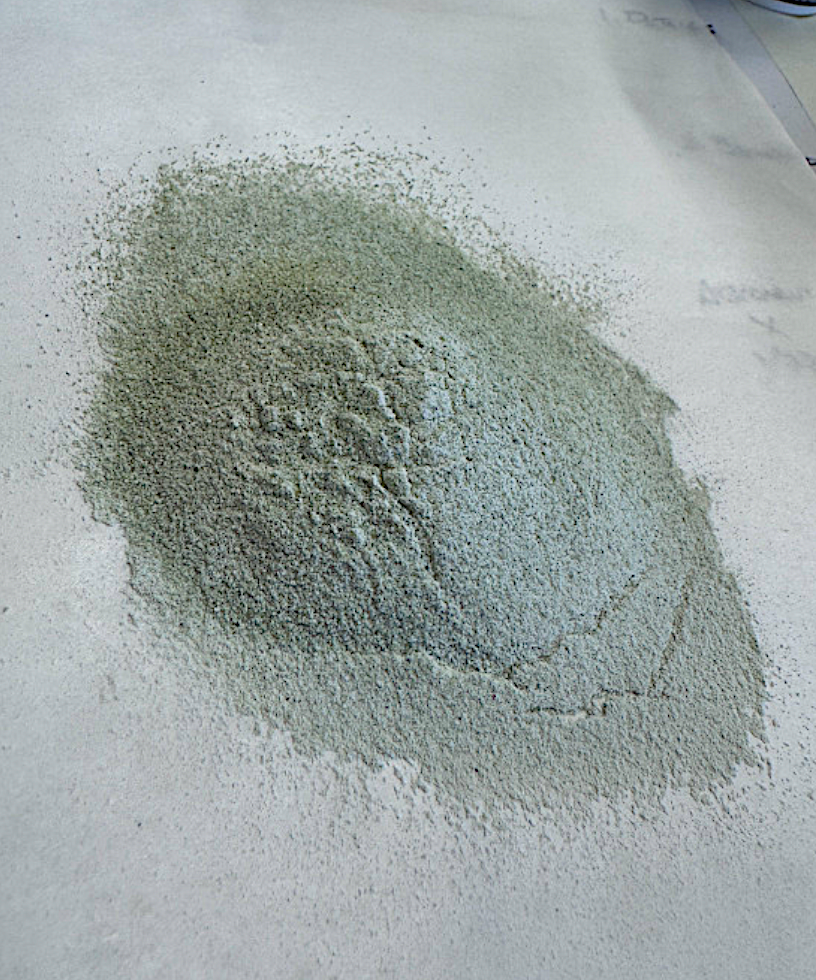
Crushing It
To create the composite used for the Chronomara dial, we took lumps of relatively homogeneously coloured Connemara marble and crushed it into a powder with a big enough grain size to retain the hue and character we required.
Think rock. Think pestle and mortar. Think a lot of sieving and swearing. That's the process. Hard, manual labour, conducted over not just days, but weeks.
And then we rebuilt it, using a UV-resistant binding fluid.
Once we'd thoroughly destroyed something and resurrected it into something even more beautiful than before, we finished it by hand so the surface is flat and precisely the right thickness for playing its part our multi-layered dial.
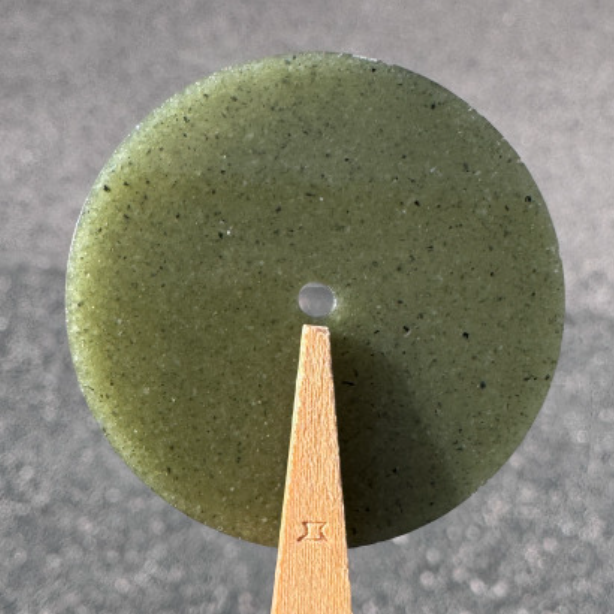
What You See Isn't Half Of What You Get
So why did we do it that way? It wasn't just to be different, but, of course, that part of our remit played its part. Our one word motto — "Discovery" — compels us to try anything and almost everything we can think of, while our mantra — "Failure is always an option — keeps our painfully fragile egos wrapped in cotton wool.
It was because we had a vision. A vision of a watch of disturbing duality. One that shows a proud, almost regal face of misty green and old gold during the day, and one that shifts and smoulders like a verdant ember on the wrist at night.
No one's ever tried to make stone glow like this. We wanted to be the first.
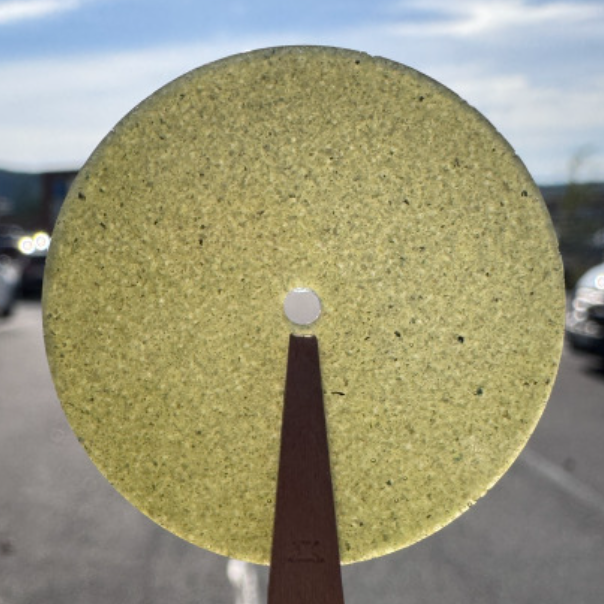
If You Want Something Doing Right...
Our unique, in-house developed dial construction lets light travel through the material. Although it's theoretically possible to slice the stone thin enough to allow light to pass through it in both directions, doing so would lose too much of the character and consistency required for a watch dial that must cause delight without distraction.
The result is neither traditional stone nor conventional lume, but a remarkably satisfying fusion of the two.
This process, which is entirely Arcanaut's, makes possible many exciting experiments for the future. And, knowing our luck, several unplanned explosions along the way to boot...
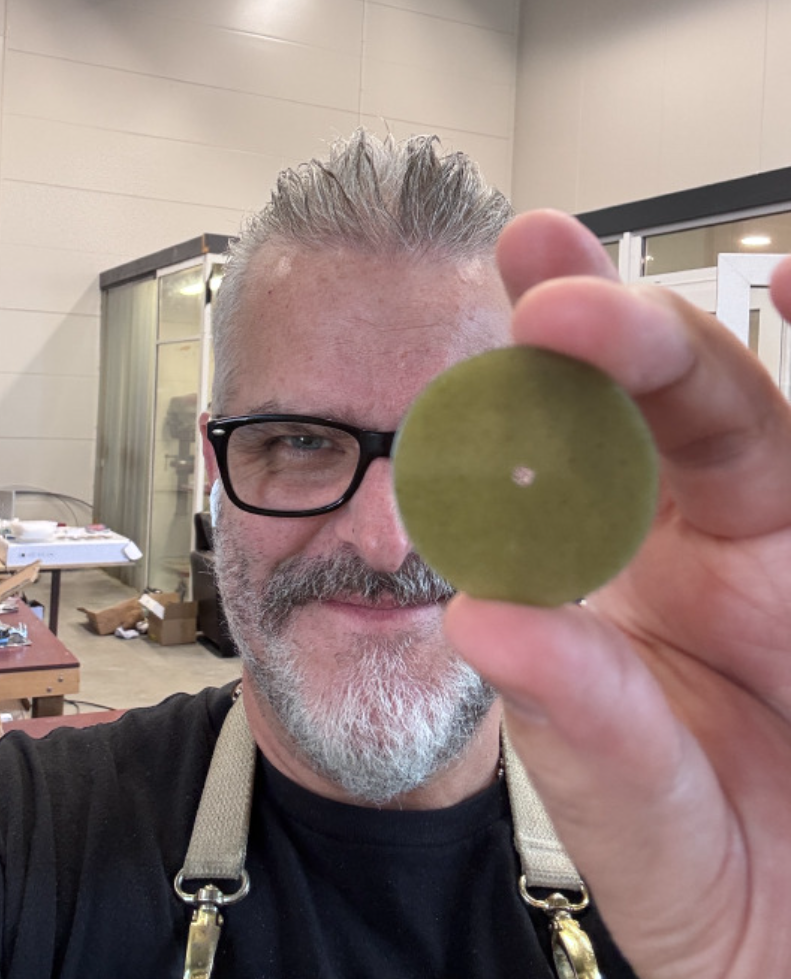
Closer to the making; closer to the makers
Because the dial development and production happen in-house at Arcanaut, we are able to keep customers closely informed throughout the journey. Those who order will receive updates along the way, along with occasional glimpses from the bench into the experimentation, refinement, and craftsmanship that go into bringing the watch to life.
To us, buying an Arcanaut should feel like more than simply making a purchase. It should feel like joining the crew of the Good Ship Arcanaut as we travel into territories unexplored.
We genuinely enjoy opening up the process and sharing the parts of watchmaking that people rarely get to see.
Just make sure you wear your safety goggles and don't stand too close. We're fond of your face where it is.
Time To Layer Up
The Arc II — Chronomara is our first commercially-available model to feature an entirely new dial system that we have been developing at Arcanaut for years, bringing together our experience in composite creation, lume performance, and structural refinement.
It combines two of our core strengths — lume and composites — in a four-layer sandwich dial architecture (five, if you count the 9-karat gold-plated stainless steel chapter ring "cup", which holds everything together) designed to enhanced the feeling of depth, arresting light play on the dial, and legibility in all conditions.
The top layer is a sapphire crystal disc, treated with a green anti-reflective coating. Beneath it sits a slightly opaque composite made from deconstructed (read: crushed) Chronomara, followed by a solid Super-LumiNova disc in a custom Kelly green developed exclusively for this project.
These three layers, each with its own texture and properties, sit atop a nickel-plated baseplate, chosen for its white tone and reflective surface, which helps charge the lume and keep it charged.
Connie, who?
Connemara marble isn't exactly the most commonly talked-about stone.
It doesn't get anywhere the pop of something like an onyx, a malachite, or, say, a Tiger's Eye.
Watchmaking has its favourites, and for good reason. The stone dials you see most brands deploying these days are ubiquitous, cheap to source, slice, and finish.
The popularity of hard stone dials has led to an increase in suppliers and the volume supplied. This, in turn, stimulates a fine-tuning of the manufacturing processes, slashing prices. The specialised processes for doing exactly this to stone dials becomes perfected. For us, that was too easy...
We wanted to take a material that has never been used in a watch at this level, and certainly not in this way. Bigger brands that demand massive volumes would hate to work with such a variable, unpredictable stone. Slicing it is possible, but finding enough pleasing slices to make a mass volume series of legible dials? Good luck.
We fell in love with Connemara marble. Whether we wanted to work with was not the question. Exactly how we did that was...
Crushing It
To create the composite used for the Chronomara dial, we took lumps of relatively homogeneously coloured Connemara marble and crushed it into a powder with a big enough grain size to retain the hue and character we required.
Think rock. Think pestle and mortar. Think a lot of sieving and swearing. That's the process. Hard, manual labour, conducted over not just days, but weeks.
And then we rebuilt it, using a UV-resistant binding fluid.
Once we'd thoroughly destroyed something and resurrected it into something even more beautiful than before, we finished it by hand so the surface is flat and precisely the right thickness for playing its part our multi-layered dial.
What You See Isn't Half Of What You Get
So why did we do it that way? It wasn't just to be different, but, of course, that part of our remit played its part. Our one word motto — "Discovery" — compels us to try anything and almost everything we can think of, while our mantra — "Failure is always an option — keeps our painfully fragile egos wrapped in cotton wool.
It was because we had a vision. A vision of a watch of disturbing duality. One that shows a proud, almost regal face of misty green and old gold during the day, and one that shifts and smoulders like a verdant ember on the wrist at night.
No one's ever tried to make stone glow like this. We wanted to be the first.
If You Want Something Doing Right...
Our unique, in-house developed dial construction lets light travel through the material. Although it's theoretically possible to slice the stone thin enough to allow light to pass through it in both directions, doing so would lose too much of the character and consistency required for a watch dial that must cause delight without distraction.
The result is neither traditional stone nor conventional lume, but a remarkably satisfying fusion of the two.
This process, which is entirely Arcanaut's, makes possible many exciting experiments for the future. And, knowing our luck, several unplanned explosions along the way to boot...
Closer to the making; closer to the makers
Because the dial development and production happen in-house at Arcanaut, we are able to keep customers closely informed throughout the journey. Those who order will receive updates along the way, along with occasional glimpses from the bench into the experimentation, refinement, and craftsmanship that go into bringing the watch to life.
To us, buying an Arcanaut should feel like more than simply making a purchase. It should feel like joining the crew of the Good Ship Arcanaut as we travel into territories unexplored.
We genuinely enjoy opening up the process and sharing the parts of watchmaking that people rarely get to see.
Just make sure you wear your safety goggles and don't stand too close. We're fond of your face where it is.
case 37 MM/40.5 MM
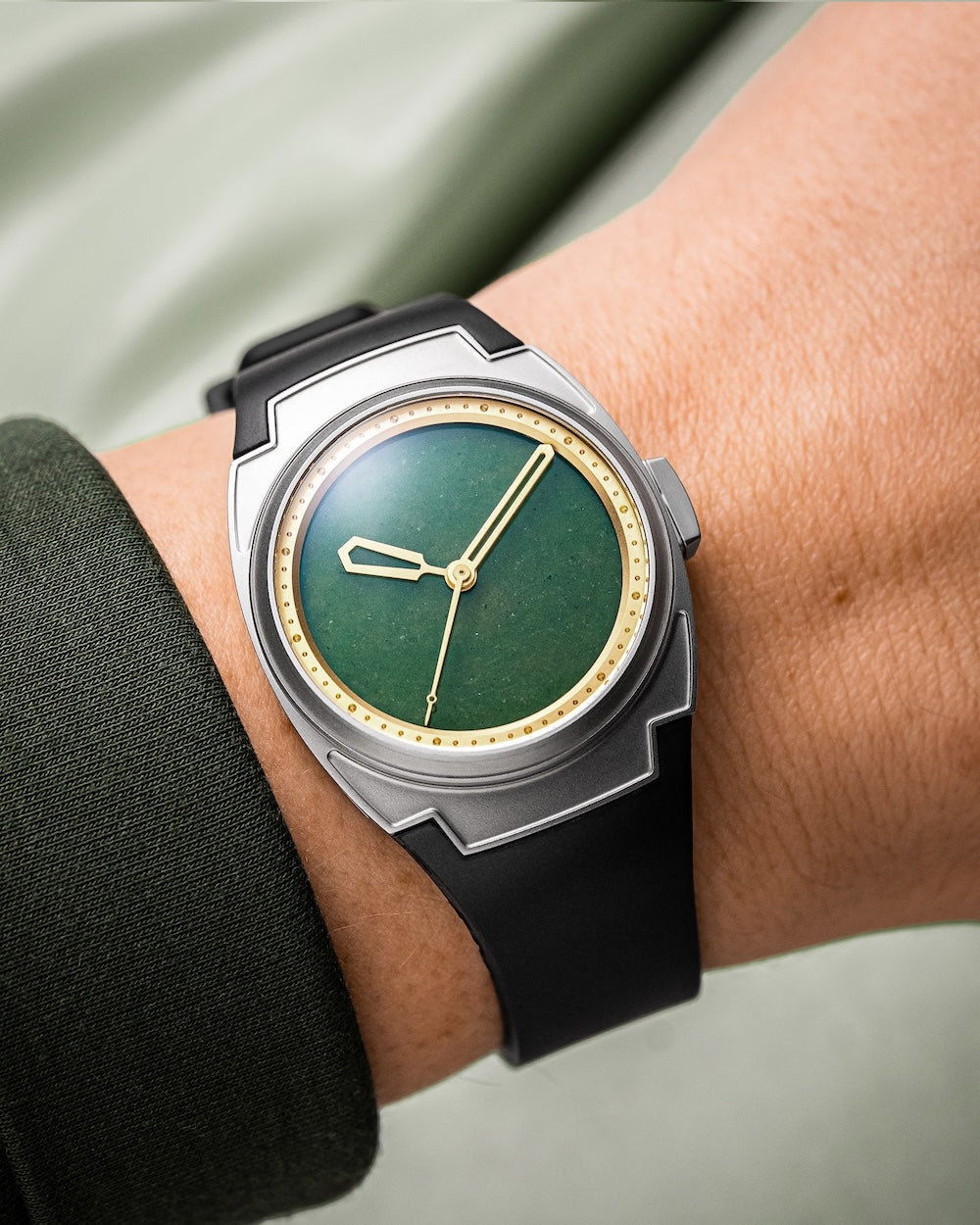
case: 37 mm
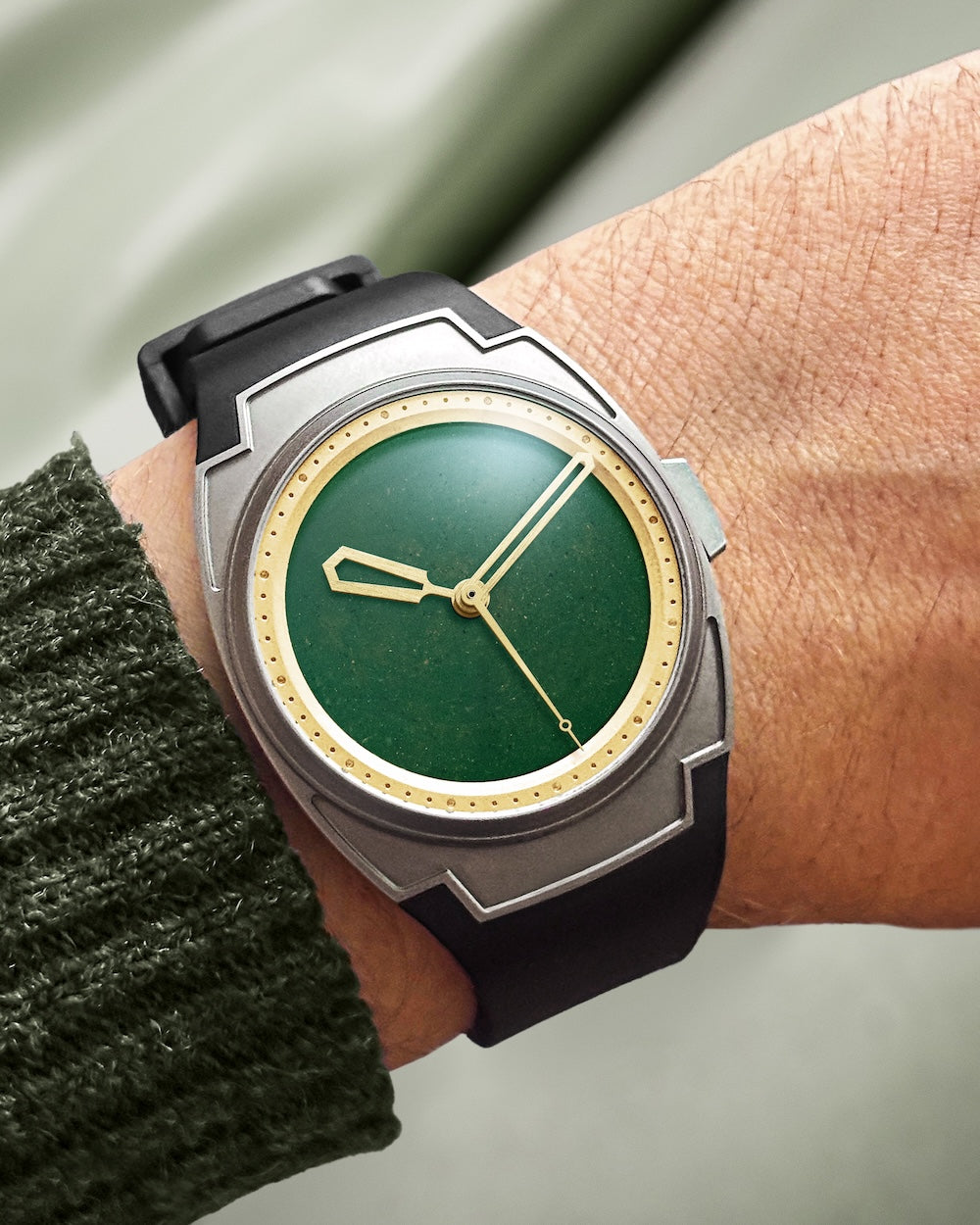
case: 40.5 mm
DIAL NIGHT/DAY
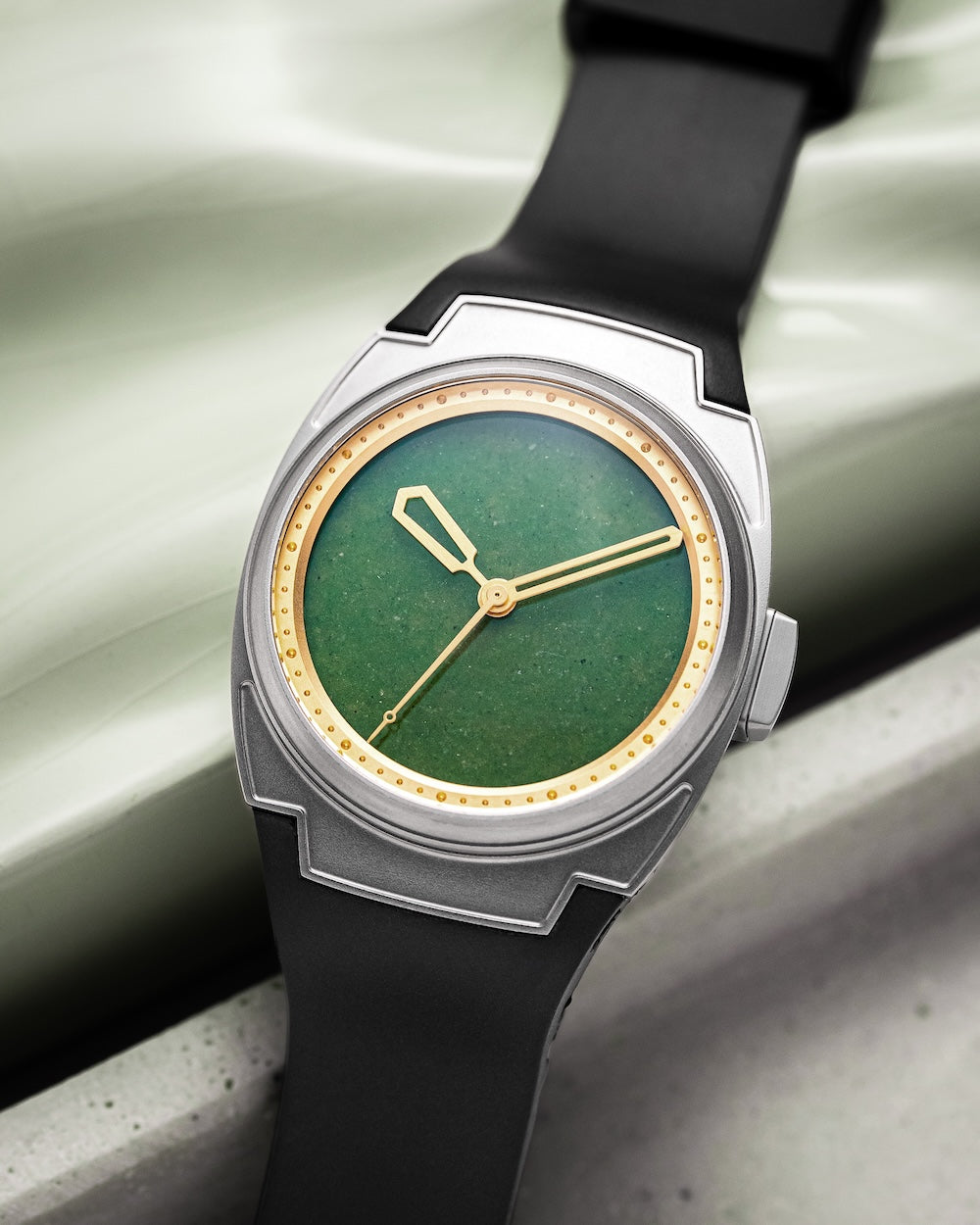
DAY
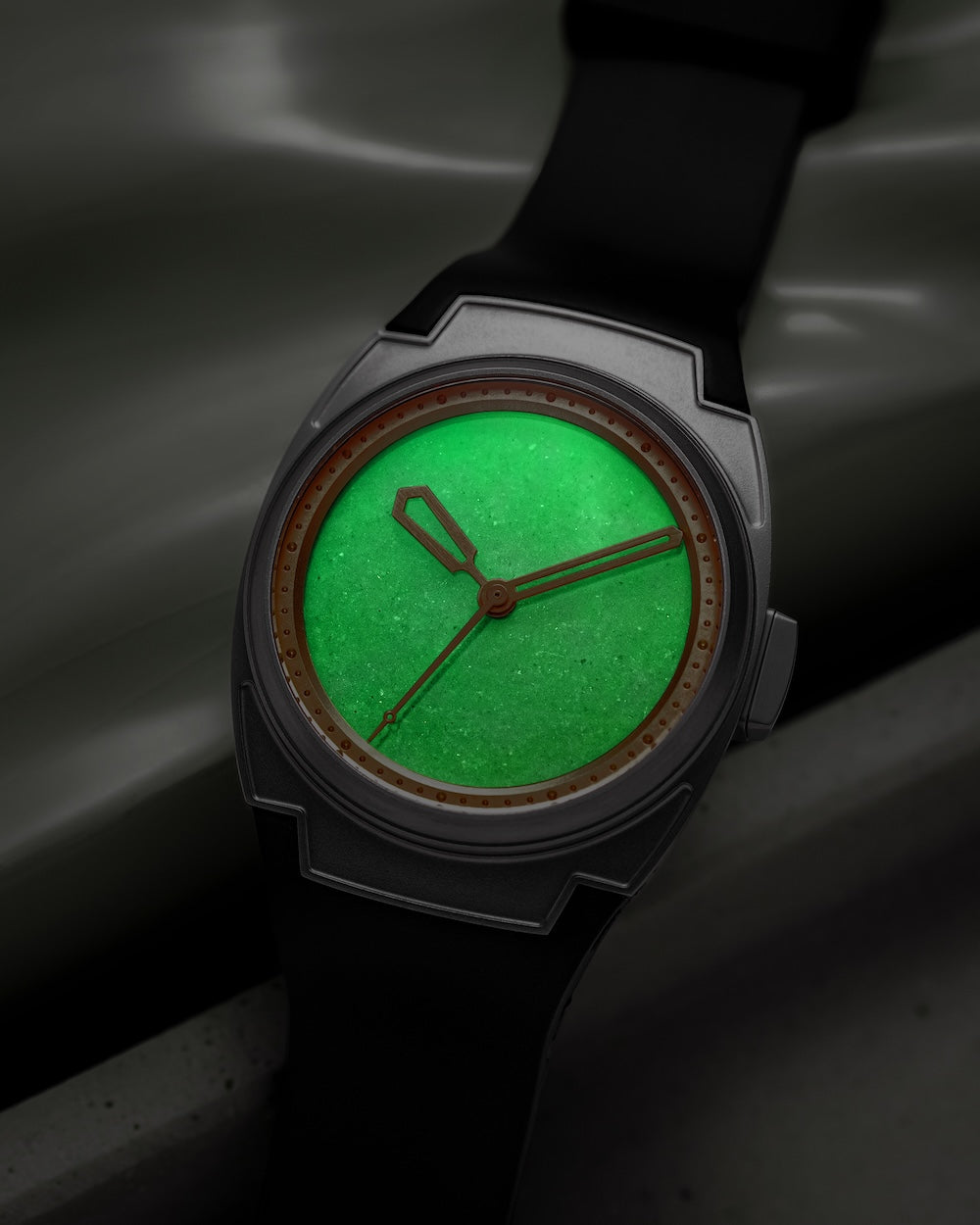
NIGHT
CASEBACK NIGHT/DAY
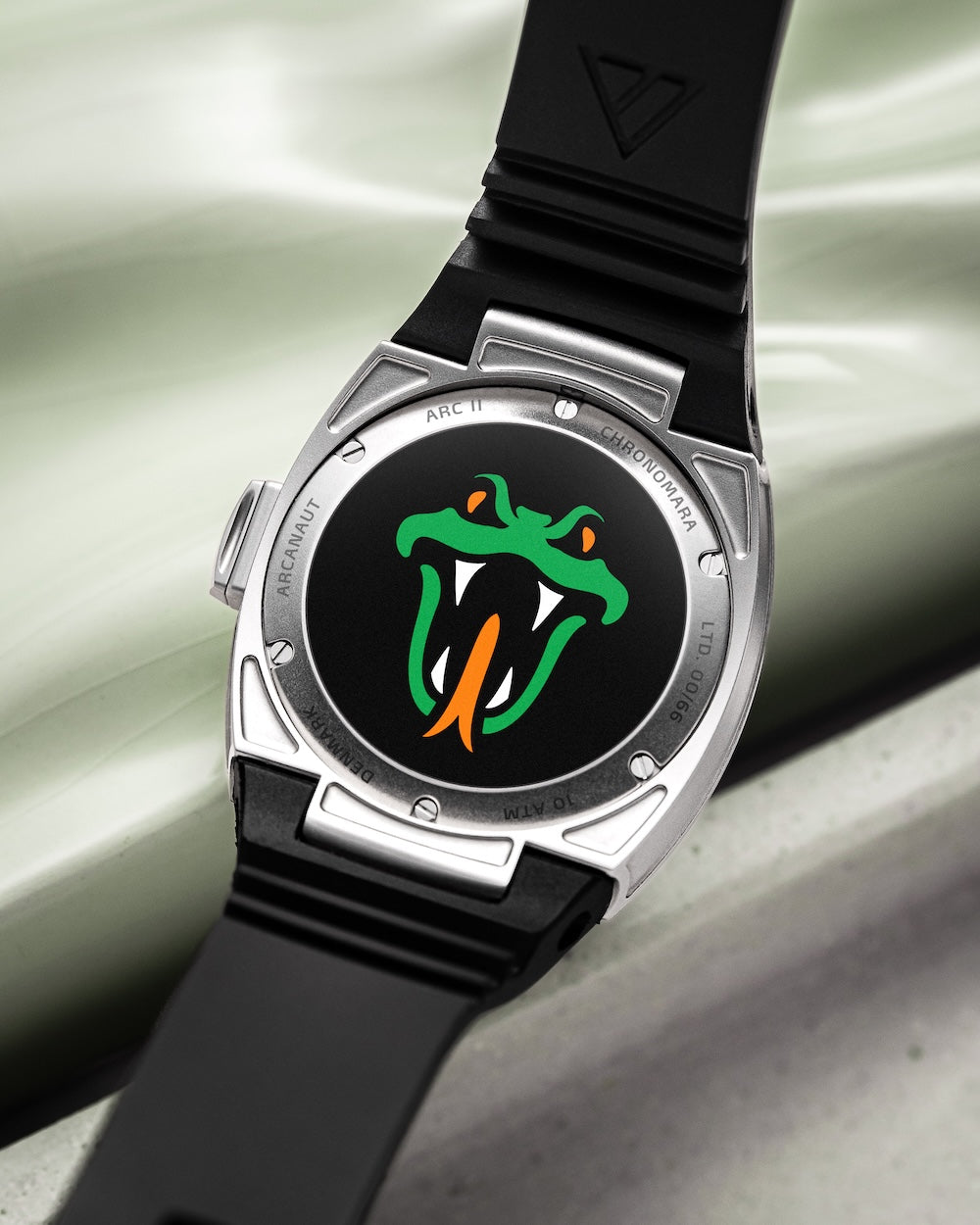
DAY
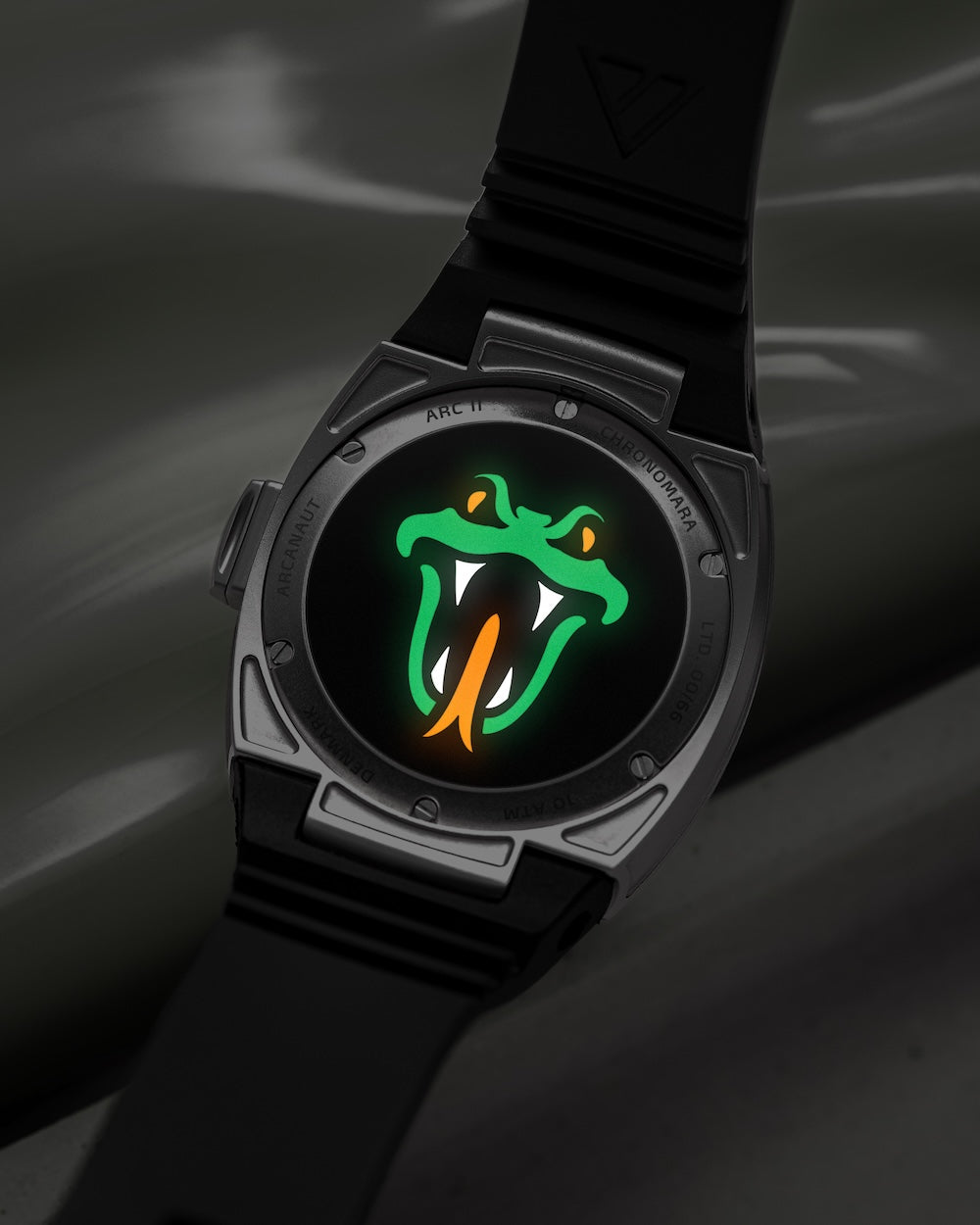
NIGHT
Technical information
40.5 mm diameter (excluding crown), and 49 mm lug-to-lug.
37 mm diameter (excluding crown), and 45 mm lug-to-lug.
Micro-blasted 316L stainless steel case with skeleton "framing"
100 m (10 ATM)
Gold plated handset (hours, minutes, and seconds)
La-Joux Perret G101, Swiss Automatic
68 hours
Natural Connemara marble, deconstructed and reconstructed into a proprietary luminous composite.
No two dials are identical.
Limited to 66 pieces in total, across both sizes
Integrated ergonomic rubber strap
"Kelly green" Super-LumiNova® colour, developed for this project.
Closed GlowPatch caseback with luminous Snake head motif.
Add-ons


